
What Is a Non-Stress Test (NST) in Pregnancy? Purpose, Timing & Results
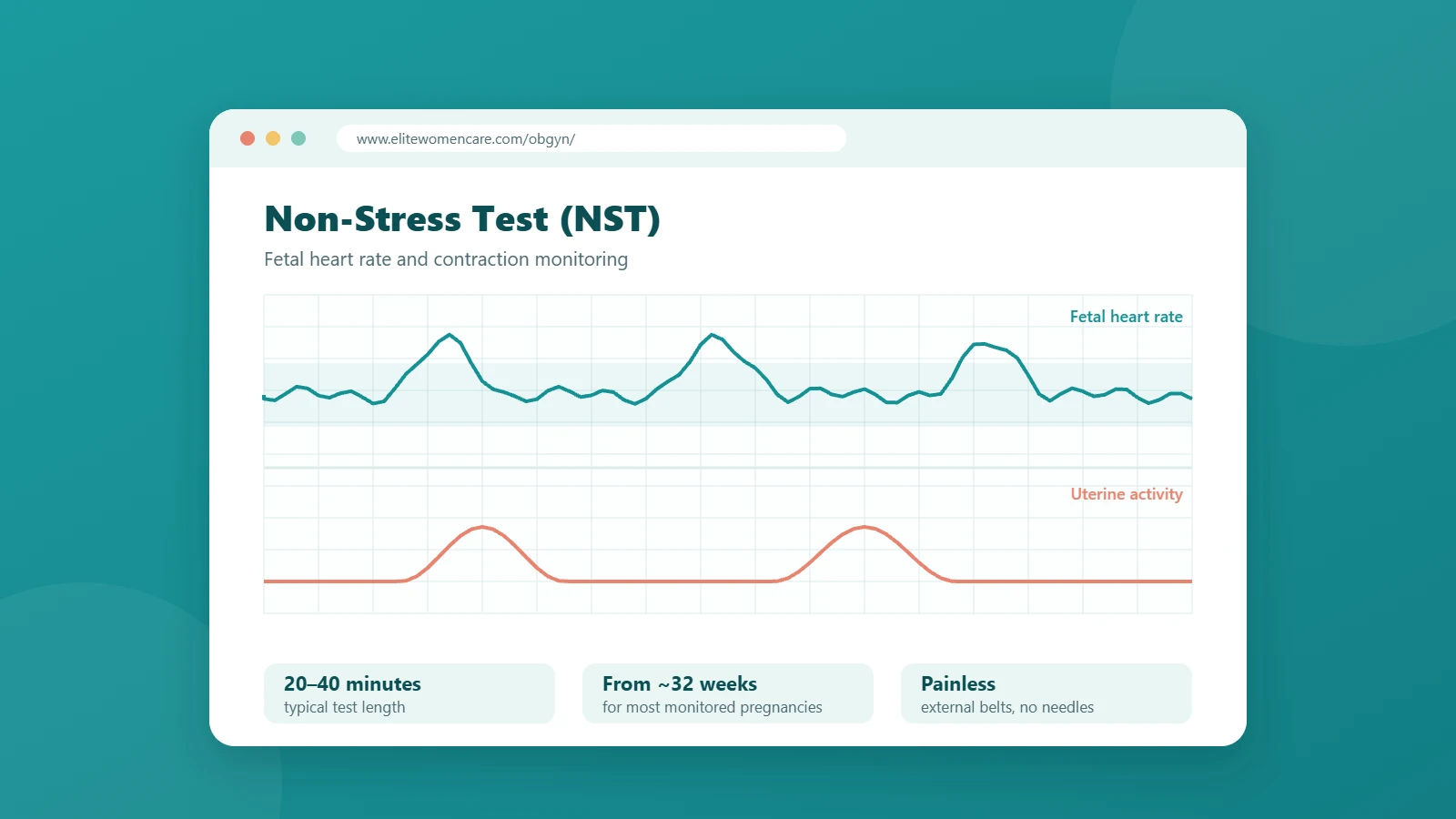
A non-stress test (NST) is a simple, painless prenatal test that checks your baby’s well-being by recording the fetal heart rate and watching how it speeds up when the baby moves. It is called “non-stress” because nothing is done to stress the baby. Two belts on your belly record the heartbeat and any contractions for about 20 to 40 minutes.
Medically reviewed by Mona Gomaa, MD, board-certified OB/GYN · Last reviewed November 13, 2026
Key Takeaways
- An NST measures your baby’s heart rate and how it responds to movement. A healthy response is called reactive.
- Most NSTs take 20 to 40 minutes; plan on about an hour for the whole visit.
- Not every pregnancy needs one. NSTs are recommended when there is a higher chance of complications, usually starting around 32 weeks.
- A non-reactive result does not mean something is wrong. It usually means more monitoring, such as a biophysical profile (BPP).
What Is a Non-Stress Test During Pregnancy?
A non-stress test during pregnancy is external fetal monitoring that shows whether your baby is getting enough oxygen through the placenta. A healthy baby’s heart rate normally rises for a short time when the baby moves, much like an adult’s heart rate rises with activity. The NST records these rises, called accelerations.
- What it measures: baseline fetal heart rate (normally 110 to 160 beats per minute), accelerations and any contractions
- Where it is done: in your OB/GYN’s office or the hospital labor and delivery unit
- Risks: none. It uses the same ultrasound sensor as a routine heartbeat check and involves no needles or medication
Why Do They Do a Stress Test During Pregnancy?
Providers do a “stress test” during pregnancy, most often a non-stress test, to confirm that the placenta is delivering enough oxygen to the baby when there is a higher chance of problems. Many people say “stress test” when they mean an NST. A true contraction stress test, which watches the baby’s heart rate during mild contractions, is used much less often today.
Testing helps your care team decide whether it is safe to continue the pregnancy or whether earlier delivery would be healthier for you and your baby.
Does Everyone Get an NST During Pregnancy?
No. Not everyone gets a non-stress test during pregnancy. NSTs are usually recommended only when a condition raises the chance of complications, such as high blood pressure, diabetes, a baby who is growing slowly, decreased fetal movement, or a pregnancy that goes past the due date. In an uncomplicated pregnancy, routine visits and kick counts are usually enough.
| Common reasons for an NST | Examples |
|---|---|
| Maternal health conditions | Chronic or gestational hypertension, preeclampsia, pre-existing or gestational diabetes, thyroid, kidney or autoimmune disease |
| Concerns about the baby | Decreased fetal movement, slowed growth (fetal growth restriction), low or high amniotic fluid |
| Pregnancy factors | Twins or more, pregnancy at 41 weeks or later, advanced maternal age (often 40+) |
| History | Previous stillbirth or complications in an earlier pregnancy |
If any of these apply to you, our high-risk pregnancy team will build a testing schedule around your needs. Learn what makes a pregnancy high risk.
When Is an NST Done in Pregnancy?
Non-stress tests usually start at about 32 weeks of pregnancy and are repeated once or twice a week until delivery. For pregnancies with higher risk, testing may start earlier, sometimes around 28 weeks. An NST can also be done at any point in the third trimester if you notice your baby moving less than usual.
- 32 weeks and later: the most common starting point
- Earlier than 32 weeks: for certain high-risk conditions
- Any time: if you notice decreased fetal movement – call us the same day
How Long Does a Non-Stress Test Take?
A non-stress test usually takes 20 minutes. If your baby is sleeping or not very active, it is extended to 40 minutes or longer to wait for the baby to wake up. With check-in, placing the monitors and reviewing the results, most patients should plan for 30 to 60 minutes in the office.
| Part of the visit | Typical time |
|---|---|
| Check-in, blood pressure, positioning | 5–10 minutes |
| Monitoring | 20 minutes (up to 40+ minutes if needed) |
| Review of results | 5–10 minutes |
| Total visit | About 30–60 minutes |
What Happens During an NST?
- You lie back in a reclining chair or tilted slightly to your left side.
- One belt with an ultrasound sensor tracks the baby’s heart rate; a second belt records any tightening of the uterus.
- You may be given a button to press each time you feel the baby move.
- If the baby seems to be asleep, a gentle sound device may be used to wake the baby.
- Your provider reviews the tracing and explains the result before you leave.
What Does an NST Look For? Reactive vs. Non-Reactive Results
An NST looks for accelerations, short rises in your baby’s heart rate. A reactive non-stress test means the heart rate rose at least 15 beats per minute for at least 15 seconds, two or more times within 20 minutes. Before 32 weeks, a rise of 10 beats for 10 seconds counts. A reactive result is reassuring.
| Result | What it means | Usual next step |
|---|---|---|
| Reactive | Baby’s heart rate responded normally; oxygen supply looks good | Continue your regular testing schedule |
| Non-reactive | Not enough accelerations during the test window; often the baby was asleep | Longer monitoring, a biophysical profile or other testing |
What Is a Biophysical Profile (BPP) in Pregnancy?
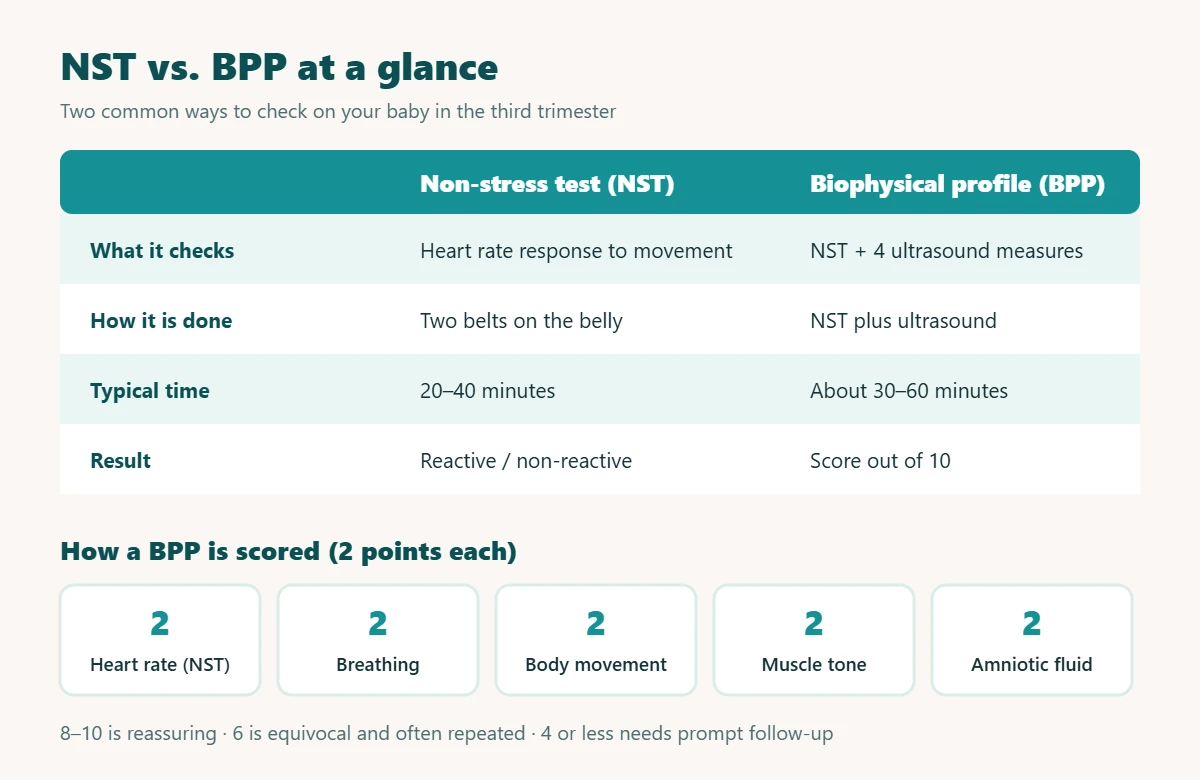
A biophysical profile (BPP) is a prenatal test that combines a non-stress test with an ultrasound to check five signs of your baby’s well-being: heart rate, breathing movements, body movements, muscle tone and amniotic fluid. Each part scores 0 or 2 points. A total of 8 to 10 is reassuring.
Why do I need a BPP ultrasound?
You may need a BPP ultrasound if your NST was non-reactive, if you have a high-risk condition, if your baby is moving less, or if your pregnancy goes past your due date. Many practices also use a modified BPP, which combines an NST with a measurement of amniotic fluid. Ultrasounds are done in our office – see our ultrasound services.
What Is a Contraction Stress Test?
A contraction stress test (CST) watches how your baby’s heart rate responds to mild uterine contractions, which are started with nipple stimulation or a low dose of oxytocin. It is done in the hospital and is used much less often than the NST and BPP, which give similar information without inducing contractions.
Prenatal Monitoring at Elite Women’s Care in Hoffman Estates
Our OB/GYNs and certified nurse midwives provide prenatal care and in-office fetal monitoring for patients in Hoffman Estates, Schaumburg, Barrington and nearby communities. If you have been told you need non-stress tests, or you are worried about your baby’s movement, book an appointment or call (847) 781-1894.
Frequently Asked Questions
Does a non-stress test hurt?
No. A non-stress test is painless and noninvasive. Two soft belts rest on your belly to record your baby’s heart rate and any contractions. There are no needles, medications or risks to you or your baby.
Should I eat before a non-stress test?
Yes, eat a normal meal or snack and drink water beforehand, unless your provider tells you otherwise. Feeling comfortable helps, and empty-bladder bathroom breaks are encouraged before monitoring starts.
What happens if my baby is asleep during the NST?
Babies have sleep cycles of 20 to 40 minutes, which is a common reason for a non-reactive result. Monitoring is simply extended, and a gentle sound device may be used to wake the baby.
Can I have a non-stress test without being high risk?
An NST may be done in a low-risk pregnancy if you notice decreased fetal movement, have unusual symptoms, or go past your due date. It is not a routine test for every pregnancy.
Sources: American College of Obstetricians and Gynecologists (ACOG) patient FAQs; ACOG Committee Opinion on indications for outpatient antenatal fetal surveillance; MedlinePlus, U.S. National Library of Medicine.
This article is for general education and is not a substitute for medical advice. If you have symptoms or questions about your health, contact your provider. In an emergency, call 911.




Comments (02)