
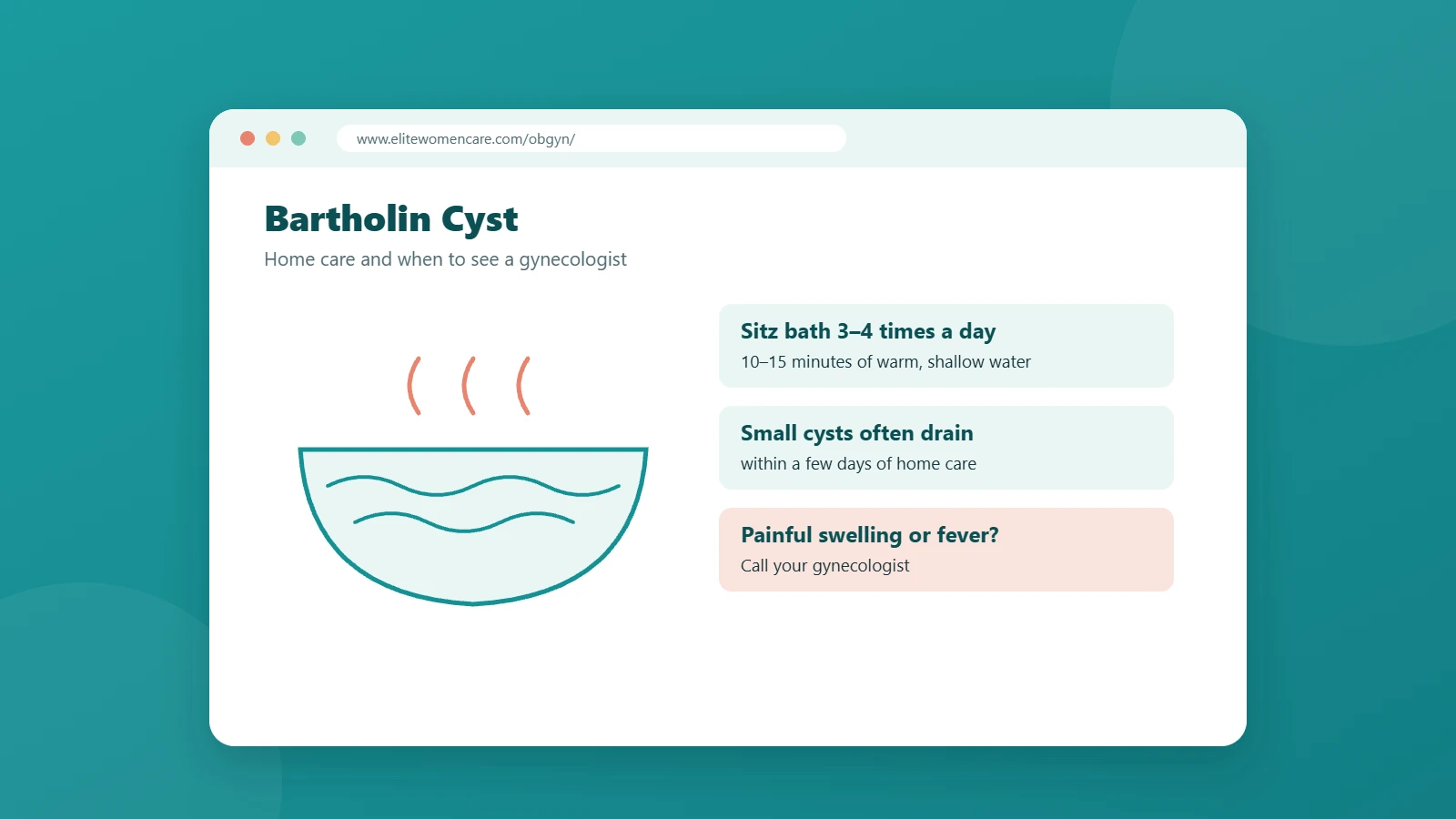
Bartholin Cyst: Will It Go Away on Its Own? Home Care & Healing Time
Yes, a small, painless Bartholin cyst often goes away on its own or with home care such as warm sitz baths, usually within a few days to a couple of weeks. A cyst that becomes painful, red and swollen may be infected (an abscess) and usually needs to be drained by a gynecologist.
Medically reviewed by Mona Gomaa, MD, board-certified OB/GYN · Last reviewed November 13, 2026
What Is a Bartholin Cyst?
A Bartholin cyst is a fluid-filled swelling on one side of the vaginal opening that forms when the duct of a Bartholin gland becomes blocked. These pea-sized glands sit at about the 4 o’clock and 8 o’clock positions and release fluid that helps lubricate the vagina. Cysts are common, are not sexually transmitted, and are usually 1 to 3 cm.
Does a Bartholin Cyst Go Away on Its Own?
Many small Bartholin cysts that do not hurt shrink or drain on their own and may not need any treatment. Home care can speed this up. A cyst that keeps growing, comes back repeatedly, or becomes painful should be checked by a gynecologist.
How to Make a Bartholin Cyst Go Away
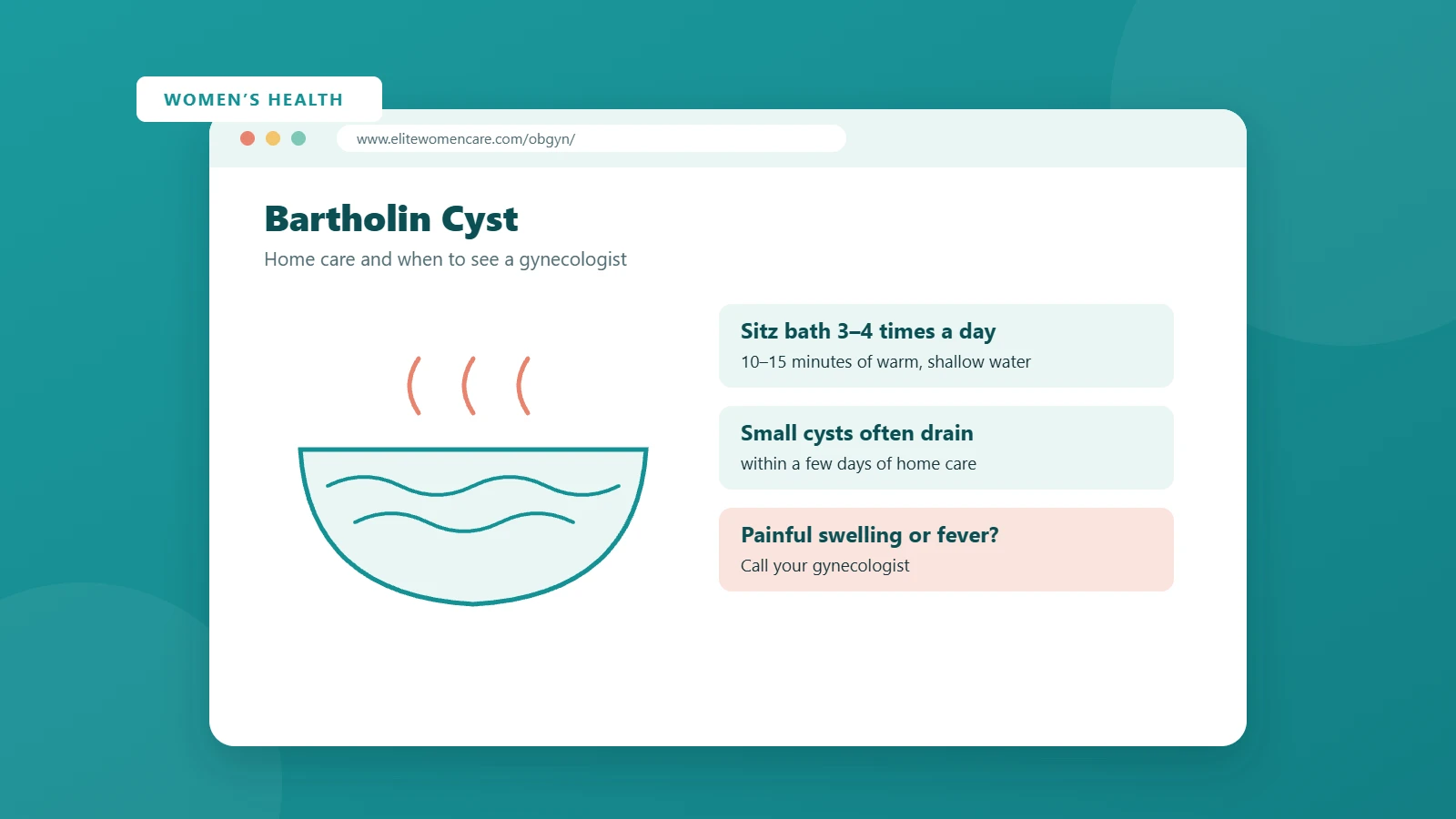
The best way to help a Bartholin cyst go away at home is to sit in a few inches of warm water (a sitz bath) for 10 to 15 minutes, three to four times a day, for several days. The warmth helps the blocked duct open and drain. Do not squeeze, pop or cut the cyst, which can cause infection.
- Take warm sitz baths 3 to 4 times a day for 3 to 4 days
- Use over-the-counter pain relief such as ibuprofen if needed
- Wear loose cotton underwear and avoid friction
- Avoid squeezing or trying to drain the cyst yourself
How Long Does It Take for a Bartholin Cyst to Go Away?
With sitz baths, a small Bartholin cyst often drains within a few days and may fully resolve in 1 to 2 weeks. If a gynecologist places a small drainage catheter, it usually stays in for 2 to 4 weeks while a new opening forms. After marsupialization, a minor procedure for recurring cysts, healing takes about 2 to 4 weeks.
| Treatment | When it is used | Typical healing time |
|---|---|---|
| Sitz baths | Small, painless or mildly tender cysts | Days to 2 weeks |
| Incision and drainage with a catheter (Word catheter) | Painful cysts or abscesses | 2–4 weeks with catheter in place |
| Marsupialization | Cysts or abscesses that keep coming back | About 2–4 weeks |
| Antibiotics | Signs of spreading infection or an STI | As prescribed |
When to See a Gynecologist
- The lump is painful, red, warm or growing quickly
- You have a fever or feel unwell
- Pain makes it hard to walk or sit
- The cyst does not improve after 3 to 4 days of sitz baths, or keeps coming back
- You are over 40 or postmenopausal and notice a new lump – a biopsy may be recommended to rule out rare gland cancer
Our gynecologists in Hoffman Estates can evaluate a vulvar lump during a gynecological check-up or a same-week visit. Book an appointment or call (847) 781-1894.
Frequently Asked Questions
Is a Bartholin cyst an STI?
No. A Bartholin cyst is caused by a blocked gland duct and is not a sexually transmitted infection. In some cases an abscess can be caused by bacteria, including STIs, so testing may be recommended.
Can I pop a Bartholin cyst at home?
No. Squeezing or cutting the cyst can push infection deeper and cause scarring. Use sitz baths, and see a gynecologist if it becomes painful so it can be drained safely.
Will a Bartholin cyst come back?
Sometimes. Cysts can recur, especially after simple drainage. If they keep coming back, a gynecologist may recommend a catheter or marsupialization to lower the chance of recurrence.
Sources: ACOG patient FAQs; MedlinePlus.
This article is for general education and is not a substitute for medical advice. If you have symptoms or questions about your health, contact your provider. In an emergency, call 911.


