
Ovarian Cysts: Can They Cause Pain, How Fast Do They Grow & Does Birth Control Help?
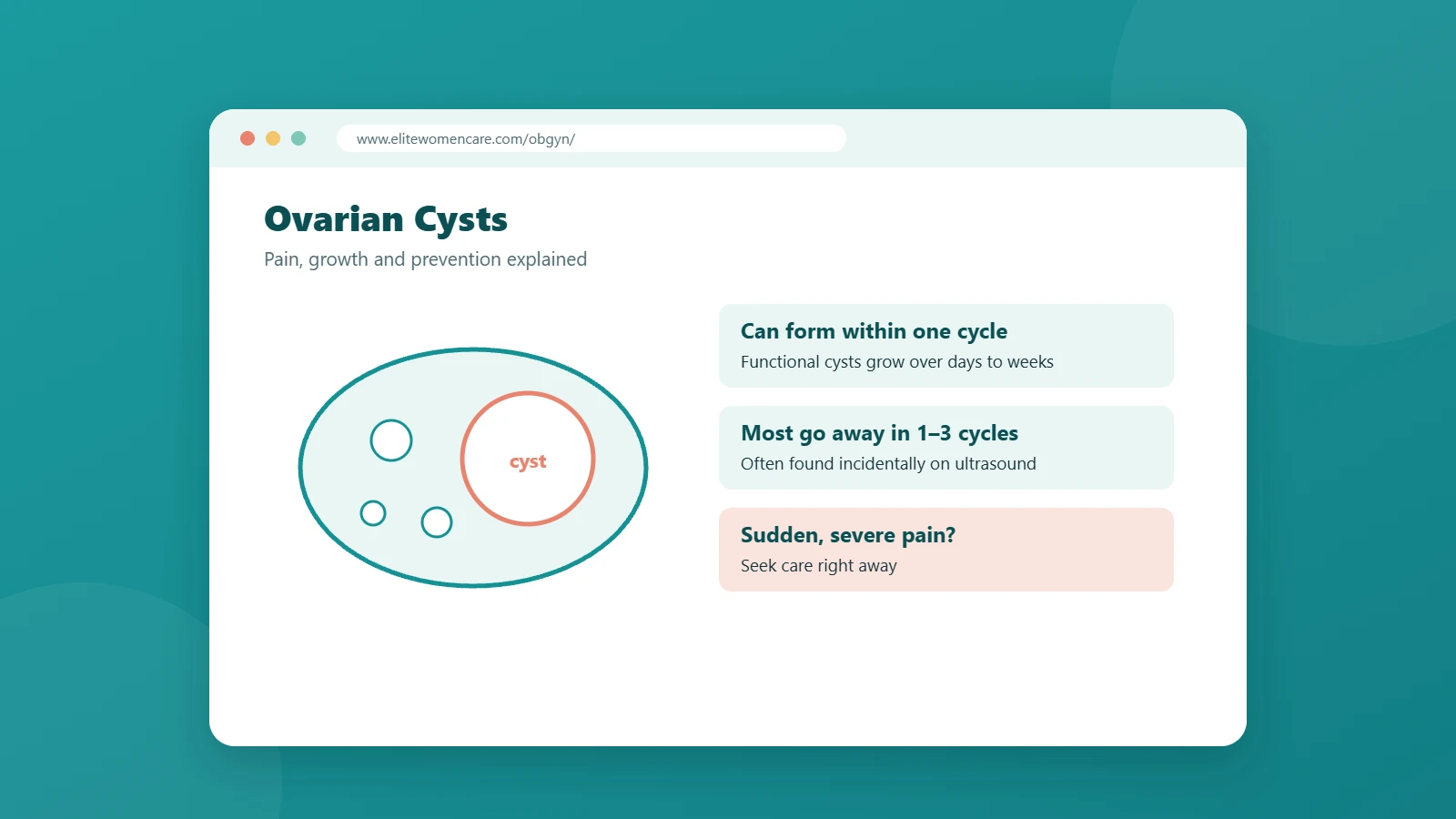
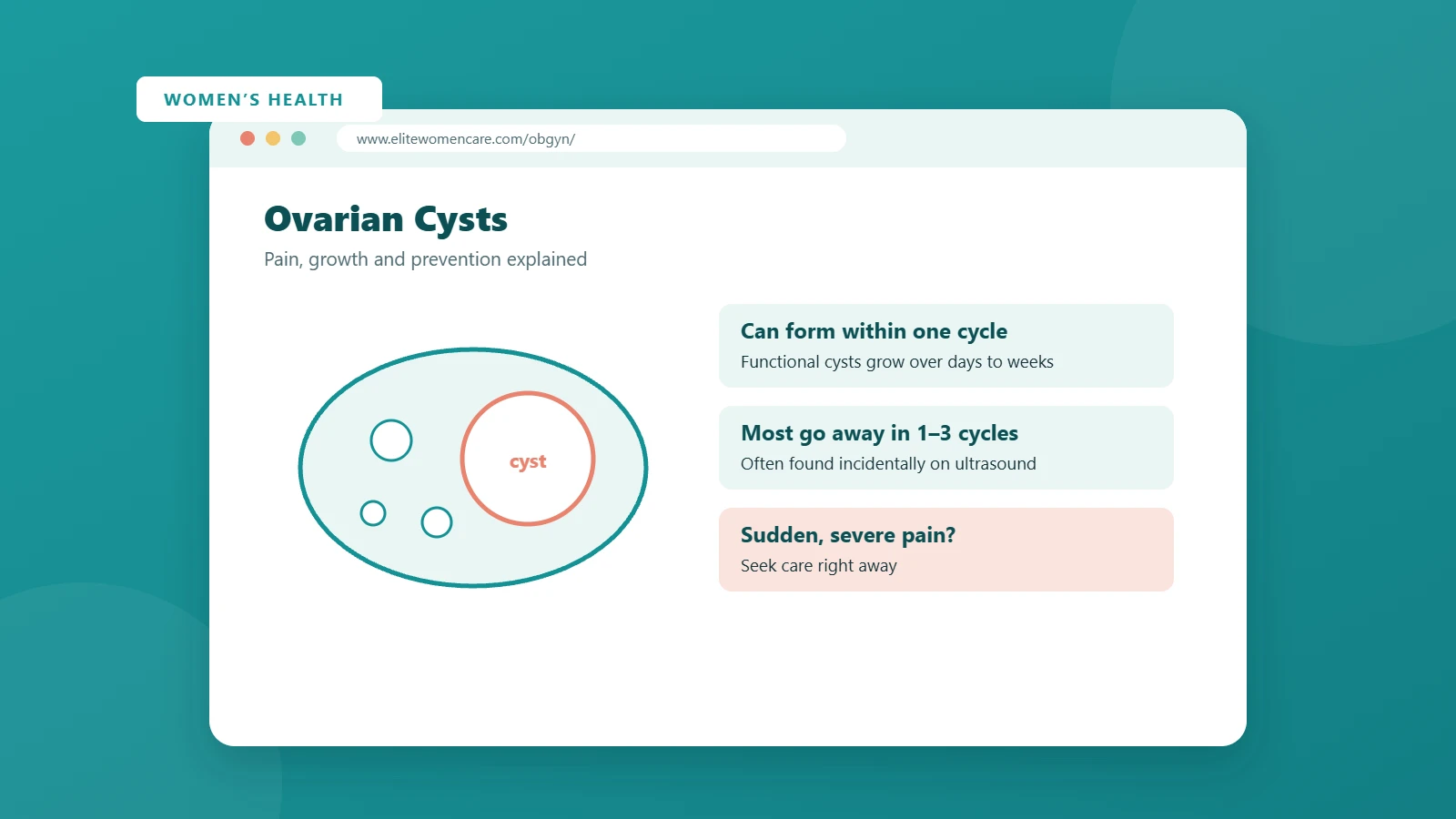
Ovarian cysts are fluid-filled sacs on or in an ovary. Most are functional cysts that form during a normal menstrual cycle, cause no symptoms and go away on their own within one to three cycles. Some cysts, even small ones, can cause pelvic pain, especially if they bleed, rupture or twist the ovary.
Medically reviewed by Mona Gomaa, MD, board-certified OB/GYN · Last reviewed November 13, 2026
How Fast Do Ovarian Cysts Develop?
Functional ovarian cysts can develop within days to a few weeks, during a single menstrual cycle, when a follicle does not release its egg or does not shrink after ovulation. Most disappear within 1 to 3 cycles (about 8 to 12 weeks). Other cyst types, such as endometriomas or dermoid cysts, grow slowly over months to years and do not go away on their own.
| Cyst type | How fast it forms | Usually goes away on its own? |
|---|---|---|
| Follicular cyst | Days to weeks, within one cycle | Yes, within 1–3 cycles |
| Corpus luteum cyst | After ovulation, within days | Yes, usually within weeks |
| Hemorrhagic cyst | Suddenly, when a functional cyst bleeds | Usually, over 6–8 weeks |
| Endometrioma (“chocolate cyst”) | Slowly, over months | No; linked to endometriosis |
| Dermoid cyst or cystadenoma | Slowly, over months to years | No; may need surgery |
Can a Small Cyst on the Ovary Cause Pain?
Yes. Most small ovarian cysts are painless, but even a small cyst can cause pain if it bleeds into itself, ruptures, or presses on nearby tissue, and some women feel a dull ache on one side around ovulation. Larger cysts, usually over 5 cm, are more likely to cause pressure, bloating or twisting of the ovary (torsion).
- Dull or achy pain on one side of the lower belly
- Pain with intercourse or during exercise
- Bloating or pelvic pressure
- Sharp pain mid-cycle that may be ovulation-related
Get emergency care for sudden, severe pelvic pain, especially with fever, vomiting, dizziness or fainting, which can signal a ruptured cyst or ovarian torsion.
Does Birth Control Prevent Ovarian Cysts?
Combined hormonal birth control (the pill, patch or ring) can help prevent new functional ovarian cysts by stopping ovulation, but it does not shrink cysts that already exist. It is often recommended for women who get frequent painful functional cysts. Progestin-only methods, such as the mini-pill or hormonal IUD, do not reliably stop ovulation and may not prevent cysts.
Talk with your provider about the best birth control option for your health history.
How Ovarian Cysts Are Diagnosed and Treated
- Pelvic ultrasound shows the size and type of the cyst. We offer ultrasound in our office.
- Watchful waiting with a repeat ultrasound in 6 to 12 weeks for simple cysts
- Pain relief with over-the-counter medication
- Surgery, usually laparoscopic, for large, persistent, painful or complex cysts
- Further evaluation for cysts after menopause, which are less likely to be functional
Ovarian cysts are also related to conditions such as PCOS and endometriosis, and can be a cause of chronic pelvic pain. Book an appointment or call (847) 781-1894.
Frequently Asked Questions
Are ovarian cysts dangerous?
Most ovarian cysts are harmless and go away on their own. Rarely, a cyst can rupture, bleed or twist the ovary, which requires urgent care. Cysts after menopause or with complex features on ultrasound need closer evaluation.
Is PCOS the same as having ovarian cysts?
No. PCOS is a hormonal condition in which the ovaries often have many small follicles that look like cysts on ultrasound. Women without PCOS can have ovarian cysts, and not all women with PCOS have visible cysts.
Can ovarian cysts affect fertility?
Functional cysts usually do not affect fertility. Cysts related to endometriosis or PCOS may make it harder to conceive, and your provider can discuss evaluation and treatment.
Sources: ACOG patient FAQs; Cochrane review of oral contraceptives for functional ovarian cysts; MedlinePlus.
This article is for general education and is not a substitute for medical advice. If you have symptoms or questions about your health, contact your provider. In an emergency, call 911.


